[ For Research Partners ]
Research-grade AI.
Production-grade infrastructure.
The compute platform research teams build on when AI has to run on real hardware. Constrained, sovereign, or air-gapped. Same model. Your environment.



Program names and logos are property of their respective owners.
[ Two Paths ]
Shrink the model. Or keep it.
The conventional path makes the model smaller until it fits the hardware. We take the opposite path. Keep the model. Make the hardware reach further.
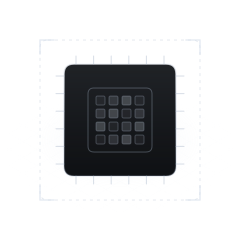
The conventional path
Shrink the model
Distil, quantise, prune. The model that ships is not the model that was trained.

The Sector88 path
Keep the model. Tier the memory.
We orchestrate model weights across whatever memory your system has available. The model that ships is the model that was trained.
[ The Hard Part ]
A systems problem. Years in the making.
Memory management, kernel selection, hardware abstraction, deployment, fleet telemetry, security hardening. All of it has to work together, on every device, in every environment.
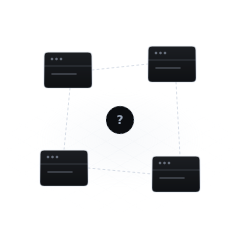
What it looks like
The duct-tape stack
Patched inference servers, custom CUDA kernels, bash scripts for deployment. Works on one machine until the hardware changes.

What we built
One integrated platform
Memory tiering, engine selection, fleet control, air-gapped deploy, audit, identity. Runs across Jetson, x86, ARM, GPU and CPU-only machines.
[ On the machine ]
Memory hierarchy.
In production.
Sector88 probes the machine, picks the engine, and tiers the model across whatever memory is available. GPU and system RAM. p95 latency stays predictable. The model that was trained is the model that serves.
Same software on a Jetson at a ground station, a research workstation, and a server rack in a SCIF.
Explore RuntimeLlama-3.3-70B-AWQ
Backend Selection
AutoMemory Hierarchy
PASS2x RTX 4090 VRAM (hot)
44.1 / 48 GB
System RAM (warm)
8.0 / 64 GB
Serving
localhost:8088/v1/chat/completions Throughput
34.8 tok/s
Latency
29 ms
OOM Events
0
Uptime
0s
[ The Platform ]
Three layers. One platform.
Fig 1.1

Across the fleet
The control plane. Manage models, nodes, and deployments across every site. Audit, RBAC, telemetry, version control.
Explore HubFig 1.2
On the machine
The execution layer. Tiered memory across VRAM and RAM. Models that should not fit run stable. GPU or CPU.
Explore RuntimeFig 1.3
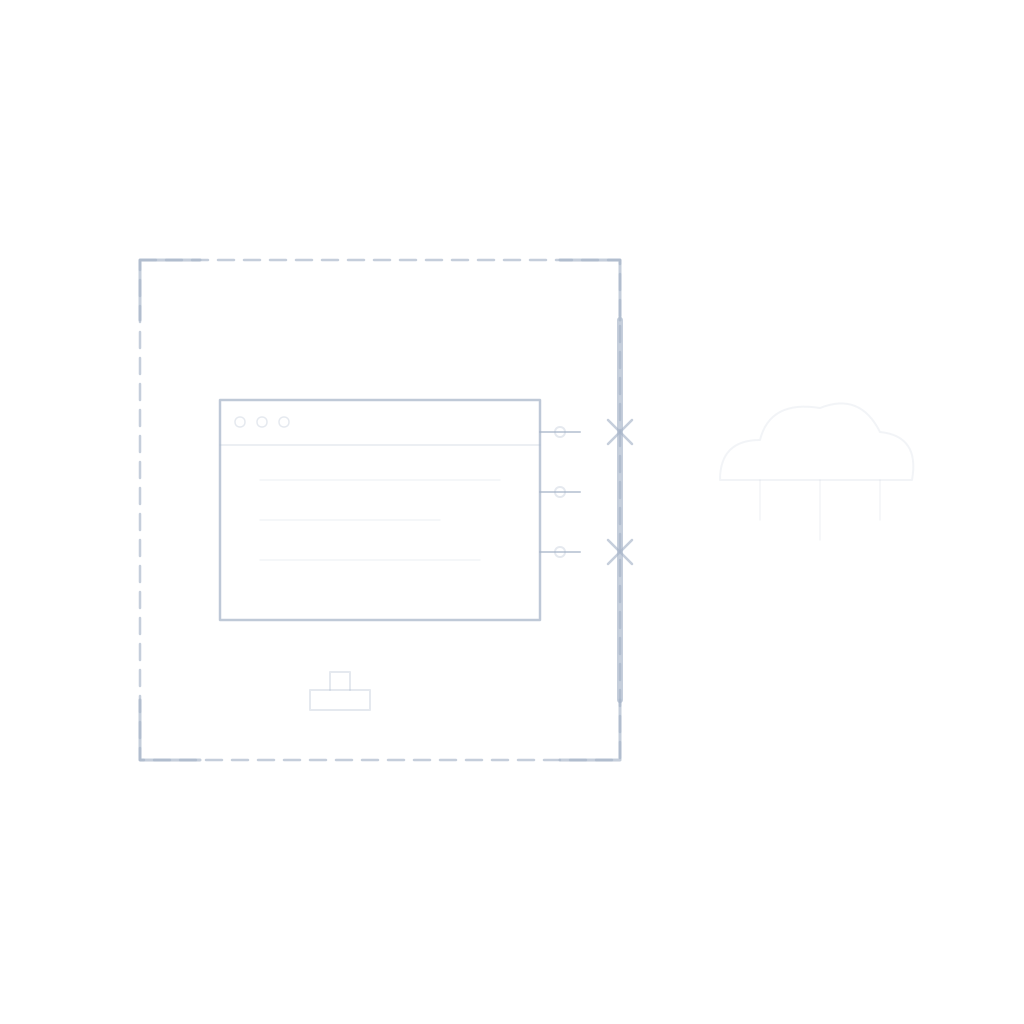
Deploy
Single Helm chart. Air-gapped install from media. No external dependencies. Same artifact from lab to ground station to facility.
Explore Deploy[ Across the fleet ]
Every node. One pane.
Pin a model, promote it, roll it back. Same model promoted across the lab, the field, and the facility.
Metadata-only audit trails. Role-based access. Telemetry stays local and resyncs when the link returns.
Explore HubNodes
128
Serving
124
Fleet Uptime
99.98%
OOM Events
0
Active Deployments
ground-station-08
Svalbard, NorwayVRAM
43.2/48
tok/s
26.4
Uptime
64d
ops-center-03
Edwards AFB, CAVRAM
71.8/80
tok/s
586.2
Uptime
31d
rig-platform-11
North Sea, OffshoreVRAM
9.6/24
fps
180.4
Uptime
112d
datacenter-sg-02
Singapore, APAC WarmingVRAM
--
tok/s
--
Uptime
0s
Activity
[ How We Engage ]
Three ways in.
We work with research partners in a few different shapes. Each one starts the same way: a real environment and a real problem.

01
Hands-on access
We give your team direct access to the platform in a real environment. You run the models, we sit alongside as you go.

02
Co-funded research
We co-apply on research programs where you bring the academic side and we bring the industry side. National and international funds.

03
Embedded partnership
Longer-term research engagements where we deploy alongside your program. Shape and terms scoped to the relationship.
[ For the Engineers ]
The technical shape.
Fig 3.1
Memory orchestration
Weight tiering across VRAM and system RAM. p95 latency stays predictable under load.
Fig 3.2
Model support
Open-weight transformers, custom fine-tunes, multimodal. vLLM, TensorRT-LLM and llama.cpp serving paths.
Fig 3.3
Validated hardware
Jetson Orin and Orin NX, industrial edge PCs, x86 with or without GPUs, CPU-only environments.
Fig 3.4
Air-gapped install
Single Helm chart. Offline model registry. Signed bundles. Zero external dependencies.
Fig 3.5
Audit and identity
Metadata-only audit trails. Admin, operator and viewer roles.
Fig 3.6

Sovereign deployment
Data stays on premises. Models stay on premises. Built for no phone-home and no outbound calls.
[ Where It Applies ]
Real environments. Real constraints.
Fig 4.1
Ground station
Vision-language model on a Jetson Orin. Imagery processed at the edge. Same artifact promotes to a server rack.
Fig 4.2
Sovereign facility
LLM on classified hardware. Air-gapped install from media. Offline licence. Built for no outbound calls.
Fig 4.3
University lab
Multi-model benchmarking across GPU generations. Auto-detect, auto-tier, version-tracked results.
[ Research Output ]
Publishable work. Not just a deployment.
Benchmarks
Latency, throughput, and memory data across hardware. Reproducible and citable.
Co-authored papers
Memory-tiered compute, edge deployment, sovereign AI. Your research, our experimental foundation.
Grant support
Deployment evidence, validation data, and industry letters for funding applications.
Build with us.
We work with a small number of research partners at a time. Tell us about the environment, the hardware, and the model you are trying to run.